
While we are appreciative of the recent rains, this drought is far from over. Here is a summary of the best resources we have available right now for managing forages during a drought. For more information, please visit the UGA Beef Drought Hub or contact your local County Extension Agent.
Hot Off The Press!
Forage: A Producer’s Guide to Drought Preparation, Management, and Recovery in the Southeastern United States.This is the first of the regional commodity guides published through the USDA Southeast Climate Hub. This guide focuses on building resilience in your forage operation, implementing adaptive management practices, and coordinating forage assessment and recovery post-drought.
Identifying Toxic Weeds in Georgia Pastures and Hayfields. Toxic weeds may be found in pastures and hayfields throughout Georgia. This resource can help you identify the most common toxic weed species on your farm and what symptoms to watch for in grazing livestock. If you suspect that your animal has consumed a toxic plant species, please contact your local veterinarian for an official diagnosis and treatment.
Recovering Fire Damaged Pastures. This is one of many resources available on the UGA Forage Team Blog. Unfortunately, there is little information on pasture recovery following wildfires in the eastern United States. Therefore, many of these generalized recommendations are a synopsis of what is found in Extension publications in the central and western parts of the country.
Social Media Resources
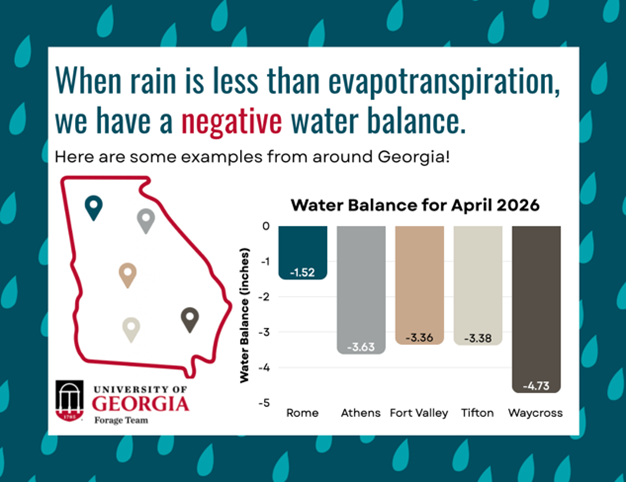
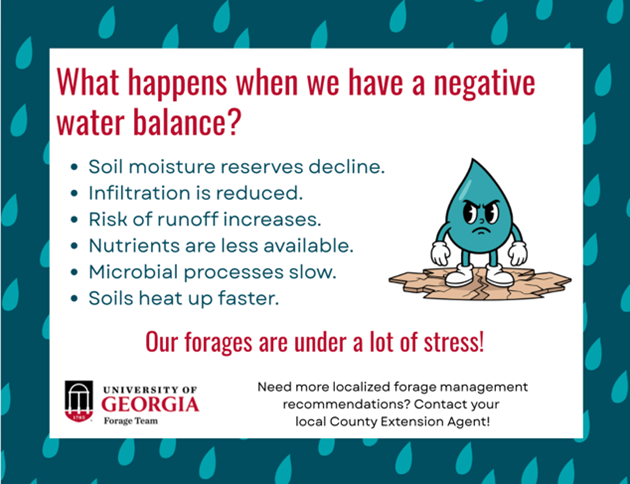
Georgia Forages Facebook. While the drought continues to evolve, our team is creating helpful infographics to break down critical weather and forage management information. These graphics can be easily shared to your local Extension, Cattlemen’s, or other social media channels. One of the recent examples illustrated the negative water balances from around Georgia and the implications on your forage stand.
Drought Webinar Series on YouTube. The first video in this series highlights how to scout and control toxic weeds in your pastures and hayfields. More videos in the series will be available in the upcoming weeks.
Frequently Asked Questions…
Here are answers to the most popular questions in the last couple of weeks that I have received from around Georgia. Have questions of your own? Please contact your local County Extension Agent! This greatly helps us identify trends across the state and determine what forage management resources can help combat these challenges.
Question: Should I fertilize my tall fescue? Answer: No! This spring growing season is done; it’s going into summer slump with or without spring growth unfortunately.
Question: Should I fertilize my bermudagrass or bahiagrass? Answer: Not without reliable irrigation! It’s not worth the risk and your grass will be extremely prone to accumulate high nitrates at this time.
Question: Should I plant a summer annual or perennial? Answer: Not without reliable irrigation! It’s not worth the financial risk. Spend those dollars on hay and supplemental feed.
Question: Should I spray an herbicide for weed control? Answer: No! The efficacy of herbicides is greatly limited during severe droughts. Furthermore, the risk of injury to the desirable grasses is too high. You should consider mechanical control; however, be aware the mowing in extremely dry conditions can spark fires!
Question: Will the bermudagrass stem maggot (BSM) be bad this year? Answer: No idea, only time will tell! The BSM will generally be more prevalent along the Gulf Coast and Texas when we are dry in Georgia. Unfortunately, the entire region is currently in some degree of drought which has not occurred since the BSM first arrived in Georgia. Therefore, we have no idea where they will go this year!
Question: Well, what should I do then? Answer: BUY HAY! It’s going to be worse before it gets better. Purchase hay and supplemental feed while they are still available.
Key takeaway: If your county is still registering on the drought monitor, you are in drought. The best thing to do in your dryland pastures and hayfields is NOTHING.